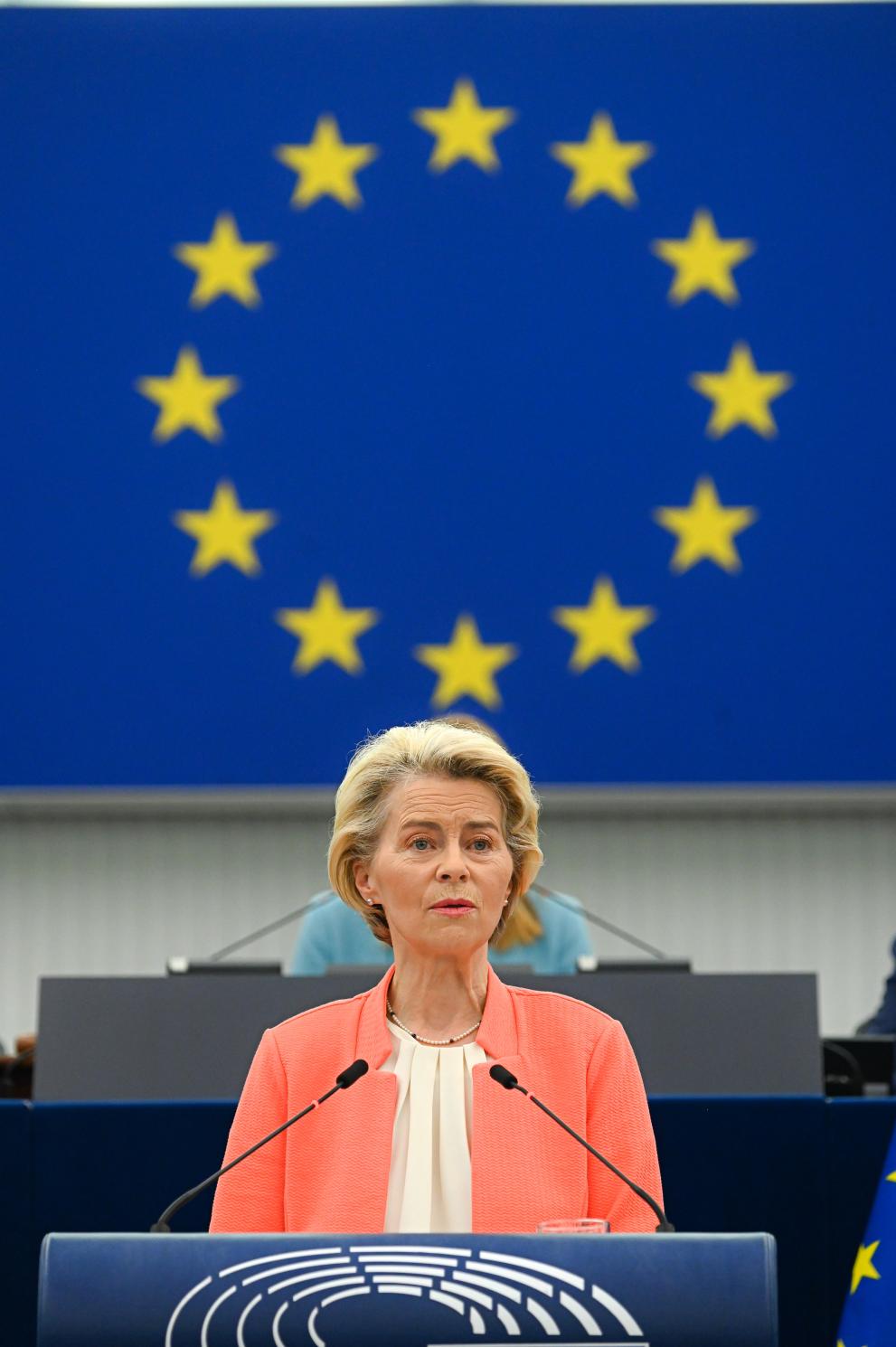
Von der Leyen make the case forclimate and economic security in her State of the Union Speech
European Commission President Ursula von der Leyen today gave her annual State of the Union speech to the European Parliament. The speech contained some new big ideas such as an associate membership for Canada, a new European Security Council and curbs on social media and AI chatbot use by children.
She also moved the dial on climate policy with a new focus on preparing for extreme weather events. She defended the EU's existing climate targets but devoted much of herattention to dealing with the consequences of drought, floods and wildfires.
The new focus on adaptation should not come at the expense of mitigation so it was good to see a re-commitment to ambitious green targets – although von der Leyen pointed the finger at member states who gold-plated a lot of climate legislation, saying it was important for the single market to be robust and competitive in the transition to net zero.
Supporting climate resilience
The EuropeanUnion is finally getting serious about climate adaptation.
For the first time, climate adaptation is no longer just an environmental portfolio, it is an economic security issue. In her annual State of the Union speech today,European Commission President Ursula von der Leyen, said Europe was woefully under-prepared for extreme weather brought about by climate change, making one thing clear: Europe’s exposure to extreme weather is rapidly becoming a systemic solvency issue for key industrial and agricultural sectors.
The summer heatwaves have seen 35 000 additional deaths, 12 million tonnes of crops lost, and 660,000 hectares burnt to the ground. Data from the European Environment Agency shows that extreme weather cost the EU economy over 200 billion in economic losses between 2021 and 2024. Yet only around 25 % of catastrophe losses in Europe are covered by private insurance. Von der Leyen's proposal to launch a Climate Insurance Alliance alongside next month’s Climate Resilience Framework signals a welcome step toward structural risk management.
The answer can’t just be ever higher insurance premiums or for governments - and individuals -to be expected to bear the cost of uninsured losses. A comprehensive public policy response - with the full participation of insurance companies - need to form the basis of a sustainable solution.
The climate resilience package will “identify 100 of the most vulnerable territories in Europe”. But it must do more than that. It must include proactive investment in landscape-scale protection and a robust set of measures that will encourage drought-resistant crops, nature-based solutions, flood prevention and energy-efficient cooling.
Farmers and land managers sit at the core of this transition. They have been exposed to poor yields and high costs as a result of the extreme weather. However, it is good to see the EU is starting to recognise the hugely important role that farmers can play in increasing our resilience to climate change. As land managers, farmers can create fire-resistant landscapes, reduce vegetation that fuels fires through grazing and restore wetlands, peatlands and floodplains.
But it is important that the new strategy, when it comes, should be nothing less than a transformative shift from only compensating a farmer after a climate disaster event towards supporting measures they take that mitigate against extreme weather damage.
The announcement of a new water initiative added to the theme of environmental resilience. It aims to address water scarcity resulting from record-breaking droughts this summer. It will also tackle water risk management in the agricultural sector, stressing the importance for food security. It’s not yet clear whether this will include binding targets or how it complements the Water Resilience Strategy announced last year.
Von der Leyen made some encouraging noises on climate adaptation and preparedness today - and she was right to say that it was not about making a choice between mitigation or adaptation: She said,“we need both. And they need to strengthen each other. This is the only way to reach climate resilience.” However, the ambition of policy responses must meet the scale of the challenge - and we will find out soon enough if they do.
Green Targets, Red Tape and GoldPlates
President vonder Leyen told MEPs that she wants to keep the green targets but ditch the redtape – and prevent the gold plating.
The Commission president gave a robust defence of the EU’s green ambitions and said the EU should “stay the course on our climate targets”.
She says that the simplification process is working and that duplicative and burden some red-tape is being successfully rolled back. She claims that the 12 omnibus proposals “are reducing the administrative burden by around €17 billion a year.”
However, “simplification cannot be a one-way street”. She says member states need to play their part by resisting the temptation to gold-plate EU legislation (where new national requirements are added as they are transposed into national law). She said, “If we are serious about simplification, we also need a pact against gold-plating”.
The single market needs to be more competitive while transitioning to a more sustainable economy - and regulatory burdens would put Europe at a disadvantage to China and others. Von der Leyen noted “We are more than 80 % dependent on China for many critical raw materials”. She said the EU will establish a new European Corporation on Critical Raw Materials to help obtain and stockpile what is needed for electric cars, chips and batteries, clean tech and defence.
The leader of the EPP Group in Parliament, Manfred Weber, in his response to the speech,cautioned against rushing toward net zero targets if it makes Europe’s economy uncompetitive, increases the cost of living or leads to job losses. The EU, he said should respond to public concerns by “not lecturing people but listening to people.” He said the EPP will fight to reverse the combustion engine ban and loosen up carbon emission rules for businesses.
Weber concludes: “Climate change is a reality, and we have to work hard against it but we have to do it together with people, not against.”